Exploratory Essay
Written: 12/19/25 | Meaning and Religion
Meaning and Religion
Humans have believed in Gods for as long as recorded history can show us, but why? Were they divinely inspired, or are they just a result of our evolution? Can society find meaning and be successful without religion? As someone brought up in a believing system, I found myself constantly questioning the fundamentals of belief, and I figured that going through the origins of religion and some human psychology, I would get some insight into the objectivity and meaning of believing in a higher power.
At first glance, I'd think that it would be tricky to actually prove whether or not one's belief system is the correct one. It is also evident from my religious surroundings that believing in a higher power and an afterlife is extremely comforting, and if one was raised with the belief, just the thought of being incorrect may cause panic and cognitive dissonance. Challenging one's upbringing is often uncomfortable, but I implore everyone reading to read with as little bias as possible, even though I knowingly have a secular bias. I say this because I want this to be logical and academic and not too abstract; otherwise, we won't actually get anywhere.
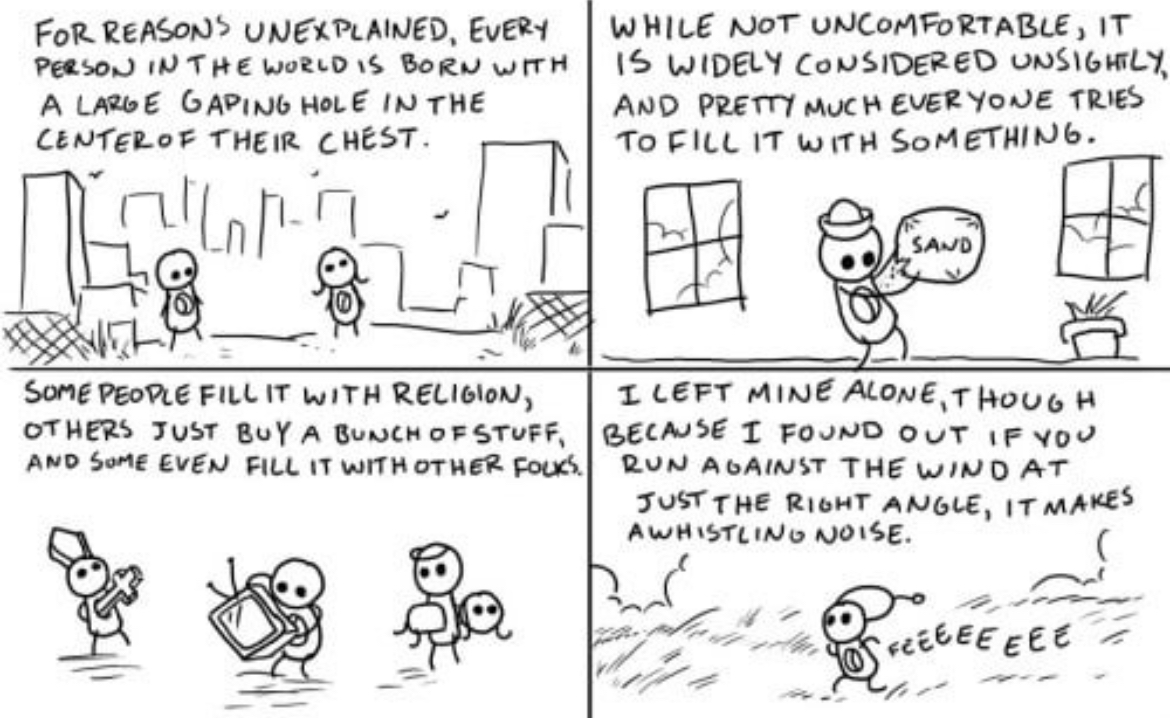 For whatever reason, it appears that "consciousness itself is constantly searching for meaning in order to stabilise its own existence and to relieve the constraints caused by the unknowable" (Otte 3). I see this just by looking around at the society around me. I discovered an excellent image (shown on the left) representing what I see around the world. It also shows that one can be comforted simply by living life, and I think this is becoming a more prevalent view in our modern day. At the same time, "there is a 'naturalness' to religious imagination and the human quest for meaning (qtd. in Bernice 2), and most of human life is instilled with ethics. (Bernice 2)
Why is this the case? Is it because of divine will? If I follow that assumption, then I'd go down the rabbit hole of trying to figure out which religion is correct, which is a completely different topic based on an assumption that I have yet to see adequate evidence for. The other option, which I see as likely, is that there is some kind of evolutionary and psychological explanation for why these traits occur in humans. Bernice explains that because of "the construction of the human niche, the aptitude for belief emerged as a noteworthy component generating a dynamic set of advantages and limitations on human lives enabled through human cognition, thought, and perception. The construction of the human niche consequently involved the origin of a shared imagination and a set of distinctive socio-cognitive processes."
This explanation makes sense, but this would also seem to say that there is no objectivity behind the moral code our societies developed; it just exists as a survival mechanism for the human species. Well, now we come to the painfully simple question of why we should follow these "fake" standards? Instead, we should go do whatever we want. Why don't we? I assume because most people are still restricted by fellow people, and even if it is "fake" in a way, these morals are still engraved in society and in individuals.
If society decided to throw away all developed guidelines, we'd either go extinct, technically making evolution fail on itself, or we'd develop new "fake" guidelines for humanity to survive. Bernice, quoting Serfontein, states "that human beings were enabled to create meaning in unique ways by behavioural and cognitive agility combined with increasing social cooperation and coordination, as well as the development of and experimentation with symbolic thought." Either our conscious awareness can override this evolutionarily given ability, or we can accept it and live a blind life. That doesn't sound fun, does it? When I came to this realization, I fell into the pit of nihilism. No meaning or purpose behind anyone or anything. Even if I wanted to, I couldn't fall back into the lovely life of ignorance, but without that, how could I motivate myself to do anything?
"God is dead. God remains dead. And we have killed him. Yet his shadow still looms."
— Nietzsche, The Gay Science, §125
Without an objective morality, all old structure collapses, even though emotions and instincts cling to it. Research on religious deconversion shows that many people who go through intense doubt experience it as a destabilizing mental and emotional crisis before anything changes. I personally know of multiple accounts where someone hits a point where the tension between their doubts and their inherited beliefs becomes unbearable. This is not something that happens suddenly. It is something that I've watched slowly build and destroy people until the person can no longer ignore the conflict inside them.
There are many different reactions people might have if confronted with nihilism. Some people become severely depressed, some obsess over finding meaning, and some are relieved that they have nothing they need to direct their lives towards; they can live how they want. This is the mindset I strive towards. I want to explore the world, meet new people, and experience new cultures. These kinds of actions feel meaningful, and they allow for real exploration instead of living in a little bubble your whole life.
Upon further research, I discovered that there are cultures that are currently majority secular and naturally wondered how these societies live and view the world around them. In A Secular Age by Charles Taylor, Taylor writes that "there is certainly a widespread sense of loss here, if not always of God, then at least of meaning." (552) He continues to explain exactly what I've understood by saying how this manifests itself with lots of tourists going towards the undamaged sites of earlier civilization. Humanity seems to deal with the sense of loss by experiencing and exploring what used to be accepted as truths. Taylor also explains that there is "growth of a rich vocabulary of interiority, an inner realm of thought and feeling to be explored." (539) This seems to be true when you look at the world around us. In the past, people's identities were bound by their upbringing, culture, and religion. Now, it is becoming more common for people to escape these bounds and build their own identities and worldviews, allowing for a more diverse society. This creates more opportunities for human connection and experience, which can arguably lead to some of the most meaningful experiences.
I know for myself that conversing with another person about our experiences and lives brings about some of the most meaningful interactions I've had with people. Especially when we can find things that we both relate to. There is something about relating to someone from a completely different environment that cannot be matched by someone who's shared the same experiences as you. You expect a community member to share similar experiences with you, but it is utterly fascinating when it comes from someone you've just met from another culture entirely.
There is a simple but important question that now remains. How does one live with constructed meaning? This is not a simple question because, by definition, there is no clear guide for construction. The guides humanity once relied on—and still often follows—no longer have the unquestioned authority they used to. Viktor E. Frankl has an incredible line in his book Man's Search for Meaning that I see as the starting point for building meaning. "Ultimately, man should not ask what the meaning of his life is, but rather he must recognise that it is he who is asked." (109) This means that one has to understand that instead of searching for the meaning of life, one should take responsibility for creating meaning through pursuits and commitments that provide fulfillment. Internalising this idea is necessary to construct one's own meaning.
We, as the only self-aware species ever discovered, are forced to coexist with one another. This can be done through violence, as history has shown us, or it can be done by tolerating and cooperating with other cultures and beliefs. The more secular view has become more popular in Western society as religious ideals are slowly fading. I don't think this is automatically bad. Most people I've met who share similar thoughts to me agree on the shared goal to help humanity thrive as a whole, and not just as a small group. Religions, on the other hand, are not always in such agreement. "Religiosity is positively associated with religious in-group favoritism." ("Researchers from University of Illinois")
Living meaningfully becomes less about obedience to inherited structures and more about engagement within the social world we collectively sustain. And very often, helping out our world in unique ways can build some of the most meaningful experiences. If you're still not convinced, then simply take a look at what Phil Zuckerman explains in his book Society Without God. This is a summary, but Zuckerman makes his idea very clear: Contrary to the common assumption that religious faith is necessary for a meaningful life, people in highly secular societies often report profound satisfaction, strong social bonds, and low anxiety about death or the afterlife.
For me, some of the most meaningful moments happen when I help someone, talk with someone from a completely different background, or try something new. These things don't require religion, but they still carry a sense of purpose and connection. Frankl's idea that we are "asked" to create meaning fits with this. Meaning seems to emerge from the choices we make and how we respond to life. Even without a higher power, humans find ways to act, connect, and create structure in their lives. Life appears meaningful because of these actions and experiences, showing us that it is possible to find purpose and understanding in a secular world, as well as a religious one.
Author's Note
I chose this topic because it was relatable and I was already interested in it. I started with a messy broad idea on the topic, and basically just started. I changed the name many times throughout because the focus kept changing. The essay did not have a direction, and the peer review session helped me determine what route to take and move forward while remaining on topic. I eventually completed my topic and went over it many times to make sure everything was clear and made sense. Each time, I made small changes and randomly large changes.
I used ChatGPT to help me review it the same way a peer would have. I was careful in the prompt to explicitly not allow it to give me any ideas or text, only to review and to mention what type of thing I can improve on, like emotional depth, need more focus somewhere, could use more detail somewhere, and things like that. I used Grammarly for all the grammar and just agreed with whatever it automatically advised.
Works Cited
Frankl, Viktor E. Man's Search for Meaning. Translated by Ilse Lasch, Beacon Press, 2006.
Otte, Marcel. Prehistory of Religions. 1993. ResearchGate, https://www.researchgate.net/profile/Marcel-Otte/publication/379269323_PREHISTORY-OF-RELIGIONS/links/66028f59a8baf573a1df73ed/PREHISTORY-OF-RELIGIONS.pdf.
"Researchers from University of Illinois Provide Details of New Studies and Findings in the Area of Behavior Research (Religiosity as a Predictor of in-Group Favoritism within and between Religious Groups)." Psychology & Psychiatry Journal, 15 Oct. 2016, p. 578. EBSCOhost, research.ebsco.com/linkprocessor/plink?id=04ff58ee-8c11-382d-aa9a-6b475384aa2e.
Serfontein, Bernice. "Evolving Belief and Being Human: The Emergence of Religion in Science and Theology." Verbum et Ecclesia, vol. 45, no. 1, Jan. 2024, pp. 1–8. EBSCOhost, https://doi.org/10.4102/ve.v45i1.2931.
Taylor, Charles. A Secular Age / Charles Taylor. Belknap Press of Harvard University Press, 2007.
Zuckerman, Phil. Society Without God, Second Edition: What the Least Religious Nations Can Tell Us About Contentment. Second edition, NYU Press, 2020. EBSCOhost, research.ebsco.com/linkprocessor/plink?id=7ab978d9-9dff-3dd8-a06b-8ed70c2fea3d.